SMS Marketing Strategy: Turn Texts Into Repeat Customers
Build an SMS marketing strategy that turns one-time buyers into loyal customers. Follow our 6-step plan to send compliant texts that bring them back.

KEY TAKEAWAYS
- An SMS marketing strategy is a documented plan for who you send marketing texts to and how each message moves a customer down the sales funnel.
- Give each SMS program one goal and one KPI to track, so you can see which texts actually drive bookings or repeat sales.
- Lock in compliance before your first send by collecting express written consent and registering your number through 10DLC or toll-free verification.
- Segment your list and automate key moments like appointment reminders and rebooking nudges, so each text fits where a customer is in their relationship with your business.
Without an SMS marketing strategy, texts go out as one-off blasts that bring a quick bump in bookings and then fade. A clear plan turns those same messages into a steady source of repeat revenue while keeping every send within opt-in and consent rules.
Residential cleaning company CottageCare shows how SMS marketing works when there's a clear plan behind it. They send simple texts, like appointment reminders that reduce no-shows, alerts when a new booking slot opens, and nudges to schedule seasonal cleanings.
With that plan in place, CottageCare managers report two to three additional sales per week from text outreach alone. Your business can get the same kind of lift by backing your texts with a plan, so every message gives customers a reason to book again.
This guide walks through six steps to build a text marketing strategy like CottageCare's, helping turn one-time buyers into loyal customers.
Step 1: Pick One Business Goal Per Program
An SMS program is a recurring set of texts built around one job, such as appointment reminders or a win-back sequence for lapsed customers. The quickest way to stall an SMS strategy is to ask one program to do everything at once. A text that tries to drive a sale and request a review in the same message usually does neither well, and you can't tell which part worked.
Giving each program a single goal solves both problems. The message stays focused, and you have one metric that shows whether the program is working.
The key to a successful marketing strategy is crystal-clear objectives. A review of goal-setting studies in Psychological Bulletin found that people working toward specific goals outperformed those told to "do their best" in 90% of the studies examined.
For your SMS program, that means a target like "cut no-shows by a third this quarter" will drive better planning than a general aim to send more reminders.
Choose one goal from the table below for each SMS marketing campaign you run, then track the KPI to measure your success.
Step 2: Lock in Compliance Before Your First Send
One SMS compliance misstep can shut down a program before it starts. Carriers block texts from unregistered numbers, and the Telephone Consumer Protection Act (TCPA) allows statutory damages of $500 to $1,500 per unlawful text. Here’s how to stay compliant.
Get Express Written Consent Before You Text
Under Federal Communications Commission (FCC) rules, subscribers must agree in writing to receive automated marketing texts before you send them, and a checked box on an SMS web form counts as consent. Add language like this beside an unchecked box on every sign-up form:
“By checking this box, I agree to receive recurring automated marketing texts from [Business Name] at the number provided. Consent is not a condition of purchase. Msg & data rates may apply. Reply HELP for help or STOP to cancel.”
Follow Carrier and Federal Sending Rules
Carriers often require businesses to register local 10-digit numbers (10DLC) or verify toll-free numbers before they'll deliver texts. Approval can take a few weeks, so start early.
Once your number is approved, every program needs automatic replies for STOP and HELP.
The FCC's TCPA rules treat a reply like STOP as a valid opt-out request, and you have up to 10 business days to honor it, though removing the subscriber immediately is safest. HELP replies fall under guidelines from CTIA, the wireless industry trade association whose messaging standards carriers enforce.
Those guidelines call for HELP to return your business name and a contact for support.
Quiet hours come from 47 CFR 64.1200(c)(1), an FCC rule under the TCPA that prohibits telephone solicitations before 8 a.m. or after 9 p.m. in the recipient's local time. Some states set tighter windows, so scheduling marketing texts between 9 a.m. and 8 p.m. keeps you safely inside both.
Step 3: Grow a High-Intent Subscriber List
The best subscribers opt in at a moment when they're already interested in your business, such as while booking an appointment or paying at the register. They expect to hear from you, so they're more likely to act on your texts.
Focus on opt-in points that align with how your customers already interact with you.
Whichever opt-in points you use, give people a reason to join that matches the goal you set initially. A bookings program might offer priority access to open appointments, while a repeat sales program might lead with a first-order discount.
Step 4: Segment by Behavior and Lifecycle
Sending every text to your whole list is one of the fastest ways to drive opt-outs. A first-time customer and a loyal regular need different messages.
Segmenting by what customers do and where they are in their relationship with your business keeps every text relevant. It's the same reason CottageCare keeps separate lists for regular and occasional customers.
Here are five to start with.
To define your lapsed segment, base the window on your typical buying cycle rather than a generic number. If most customers book every four weeks, anyone who hasn't returned in eight weeks is a good candidate for a win-back text. Textedly's contact groups let you sort subscribers into these segments and send each one its own campaign.
Step 5: Map Campaigns to Your Goal
Choosing SMS marketing campaigns that match your goal keeps every send working toward a measurable outcome. The table below shows which campaigns support each goal, when to send each one, and a sample message you can adapt.
Keep each message under 160 characters so it arrives as a single text, and lead with your business name so subscribers know who's texting.
You don't need to launch every campaign at once. Use the campaign tied to your primary goal, and add the next one once the first consistently hits its target. Textedly's scheduled texts let you set up messages like reminders ahead of time, so they go out on schedule without anyone sending them by hand.
Step 6: Automate the Moments That Matter
The texts that build repeat business are tied to specific moments, like an upcoming appointment or a visit that just ended. Automating them ensures each text goes out on time, even during your busiest weeks, without anyone on your team having to remember it.
Start with these key automations:
- Welcome text: Send it within minutes of opt-in, and deliver the perk you promised at sign-up.
- Appointment reminder: Send it 24 hours ahead, then add a same-day reminder two hours before longer or higher-value appointments. Reminders make a real difference: Research found that people who got a text reminder before a healthcare appointment were 25% less likely to miss it, and multiple reminders worked better than one.
- Post-visit review request: Send it one to three hours after the visit, with a direct link to your review page.
- Rebooking nudge: Send it about a week before a customer is usually due. If they book every six weeks, that's around week five.
- Birthday offer: Send it a few days before their birthday, and keep the offer valid through the end of the month.
- Win-back drip: Start with a friendly check-in once a customer passes their usual buying window. If they don't respond, follow up a week later with an offer.
Schedule every automation between 9 a.m. and 8 p.m. in the customer's time zone to stay within quiet hours. With Textedly's automated texts, you can build each one once and let it run.
SMS Marketing Best Practices to Protect Your List
A strong strategy only pays off if subscribers stay on your list and your texts keep reaching their inboxes. These best practices for SMS marketing help you avoid the opt-outs and carrier filtering that quietly shrink your results over time.
Identify Your Business in Every Text
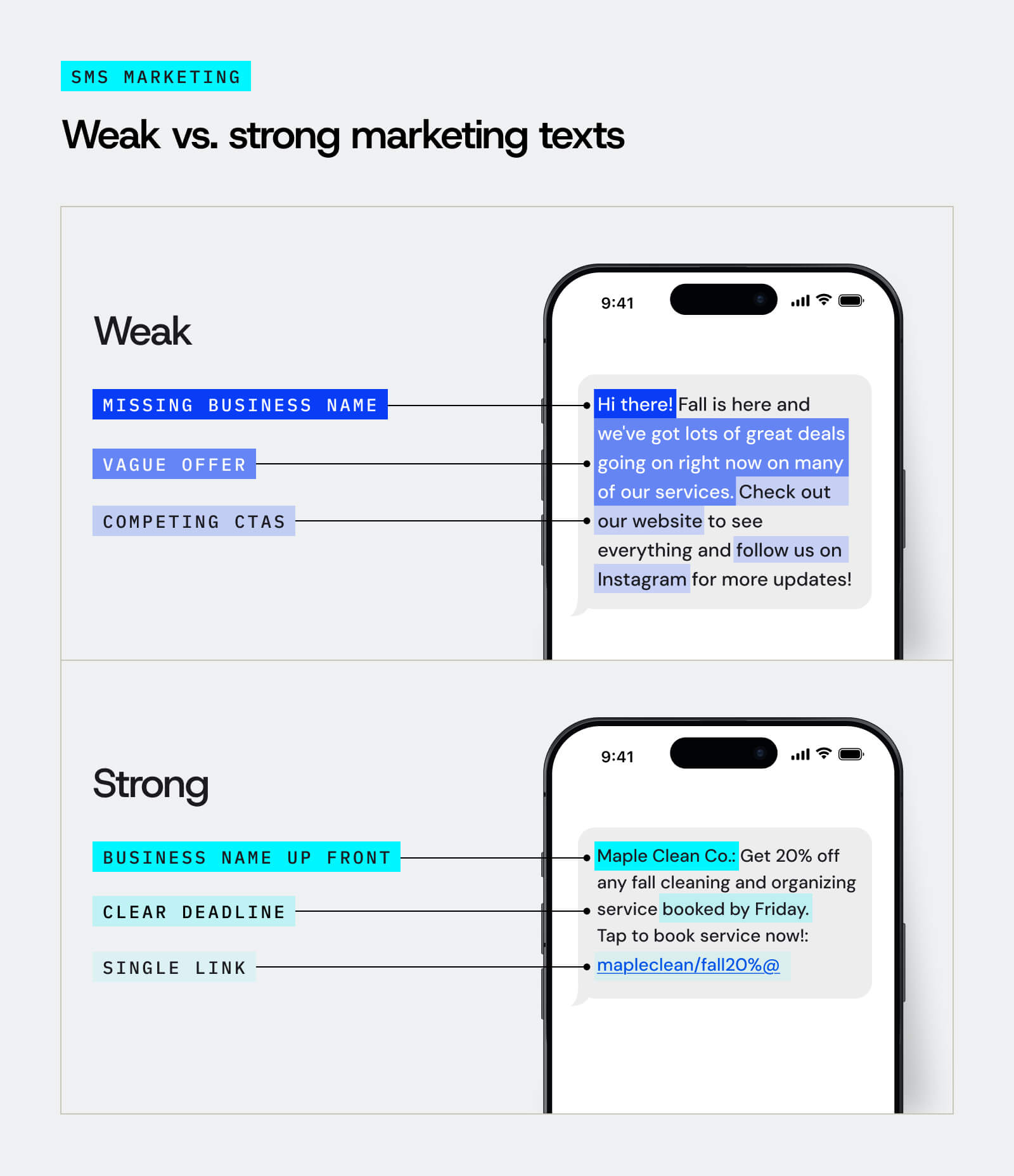
Opening each message with your business name tells subscribers who’s texting them before they read another word. Texts from an unrecognized sender are more likely to be reported as junk, and those reports can lead carriers to filter your future messages. Leading with your name keeps recipients from mistaking you for spam and protects your deliverability.
Set a Cadence and Stick to It
Start with two to four marketing texts a month, and keep that schedule consistent so subscribers know what to expect. Check the opt-out rate after every send. If it holds steady as you add messages, you have room to text more often, but if opt-outs climb, scale back to your last comfortable frequency.
Write Short Texts With One Clear CTA
Most people skim a text before deciding whether to act, so a message that asks for more than one thing usually gets no action. Long texts also cost more to send, since anything over 160 characters is split into multiple message segments and billed as multiple texts.
A short message with a single offer and one link keeps the next step obvious and your sending costs down.
Send at the Right Local Time
Quiet hours are based on the recipient's location, so a 9 a.m. text sent from New York reaches a California subscriber at 6 a.m. Group subscribers by time zone using their ZIP code or area code, then schedule each send to land within the 9 a.m. to 8 p.m. window from Step 2, which leaves room for the states that set stricter limits than federal rules.
Put Your SMS Marketing Strategy Into Action With Textedly
In an SMS marketing strategy, every text has a clear job, from the welcome message a new subscriber receives to the win-back offer that brings a lapsed customer back. Start with a single goal and a compliant subscriber list, then add campaigns and automations as each one proves its value.
Compare Textedly's plans to find the right fit for your list size and budget, or get started free and set up your first welcome text today.
Related resources:
- SMS Marketing ROI Playbook: Proven Tactics to Boost Returns
- 13 Strategies to Boost SMS Customer Engagement
- 21 Effective SMS Marketing Ideas to Supercharge Sales
- MMS vs SMS: Which Is Right for Your Marketing Campaigns?
SMS Marketing Strategy FAQ
How often should businesses send marketing texts?
Start with two to four marketing texts a month. That's enough to stay top of mind without wearing out your subscribers. From there, let your opt-out rate guide you: add sends while it holds steady, and pull back if it starts to rise.
Do you need consent to send marketing texts?
Yes. The Telephone Consumer Protection Act (TCPA) requires express written consent before a business sends automated marketing texts, and an electronic signature, such as a checked box on a sign-up form, qualifies. Your consent language should name your business and make clear that agreeing isn't required to make a purchase.
What is 10DLC registration?
10DLC registration is the process of registering your business and texting campaigns with The Campaign Registry before sending business texts from a standard 10-digit local phone number. Carriers use the registration to verify who is sending messages, and they may filter or block texts from numbers that aren't registered.
What is a good SMS click-through rate?
Click-through rates vary widely by industry and by how engaged your list is, so the most useful benchmark is your own. If you're just getting started, treat your first three to five campaigns as a baseline, then aim to beat that average with each new send. Texts with one clear offer and a single link usually see the biggest gains.
Related Articles

7 Ways to Overcome Lazy Cart Syndrome With SMS Remarketing

11 SMS Marketing KPIs to Measure Campaign Success

Automotive Text Message Marketing Ideas

13 Text Marketing Trends to Watch in 2025


Your Customers Are Waiting
Send your first text in minutes—no contracts, no credit card, no hassle.