Home Services Marketing: 11 Strategies To Get More Leads
Get more leads and book more jobs with 11 home services marketing strategies, a channel comparison, and SMS messaging templates for contractors.

KEY TAKEAWAYS
- Google Maps and Search are how most homeowners find a provider, so you need a Google Business Profile, local SEO, and plenty of reviews.
- You need to respond quickly while people are looking for home services. If you miss a call, the homeowner moves on. Voice and SMS AI agents can lead to up to 40% fewer missed opportunities after hours.
- Set up automated SMS campaigns to stay in touch with past clients and request reviews.
- Manage your resources by tracking which of your efforts result in booked work. You can use surveys to ask where clients heard about you.
Finding time to communicate with customers is difficult in home services, but almost two-thirds of buyers expect a response within 10 minutes. If you’ve ever lost a booking because you were at a job and couldn’t answer the phone, you know the struggle.
These 11 home services marketing strategies can help you book more work by attracting more leads and managing communications while you’re busy.
What Is Home Services Marketing?
Home services marketing is a specific set of strategies that help you get clients if you provide landscaping, pest control, plumbing, electrical, HVAC, cleaning, or other home-based services. Because your customers are local and the work is often seasonal or urgent, this kind of marketing requires unique approaches.
Community and trust also guide customer decisions. They’re accepting you into their home, so each interaction has high stakes. This makes reviews and word of mouth strong influencers in decision-making. People trust their neighbors over marketing claims.
11 Home Services Marketing Strategies to Get More Leads
Your local marketing pipeline for your services has three main stages: how you get found, how you turn visibility into bookings, and how you convince your existing customers to come back. Let’s look at strategies you can use in each.
1. Optimize Your Google Business Profile
Google Maps and local search results are often a homeowner’s first step. When someone searches for “plumber near me” or “AC repair in [city]” you want to show up in the results.
Keep your Google Business Profile accurate, updated, and detailed. It’s a free gateway to discoverability through maps and social proof with reviews. Here’s a quick look at what to include:
- Include your service areas, categories, and business details.
- Keep the profile updated with photos of your business, team, and work.
- Don’t forget to update your contact information and hours if they change, if you close for holidays, or if you change service areas.
2. Build a Website That Turns Visitors Into Bookings
The core of any home services digital marketing strategy is a website. Give your leads a place to learn more about you. A website is a space you own that gets users off of the platforms where they’re considering multiple choices.
Link other marketing platforms to curated landing pages focused on each service area. This keeps the experience smooth, leading users from discovery to a call, with everything in between relevant to them. Here are two features to focus on:
- Mobile-friendliness: Google prioritizes mobile compatibility, and many users perform local searches on their smartphones.
- Click-to-call and click-to-text buttons: These take the user straight to their preferred contact method, and then auto-reply templates can get them started immediately.
3. Invest in Local SEO and Helpful Content
Local SEO is the practice of boosting your website’s visibility in local search results. People search for what they need using the terms they know best. Using those terms on your website is the first step, and the next is to create helpful content about issues they encounter.
Content improves your website’s visibility because Google has more words to work with to understand who you are and what you do. Landscaping cost guides, sink troubleshooting tips, and pest identification with photos and videos can all help your discoverability online.
A few SEO tips:
- Build landing pages around “service” plus “area” phrases (pest control in Dallas) to match how people search for help.
- Search for common questions yourself to see what your competitors say, and whether there are gaps in knowledge you can fill.
- Use internal links within a page's body to direct readers to other relevant areas of the website.
4. Run Google Ads and Local Services Ads
You might not have considered ads because you operate locally, but they can be surprisingly important in digital marketing for home services.
Google ads allow you to bid on specific keywords, like service and area combinations. You pay when people click, but there’s no guarantee a click will become a call, so you need to manage the budget you spend on them.
Local service ads are designed for local businesses. They only show up on local searches relevant to your services, and you pay for leads instead of clicks. So the price is often higher, but you’re more likely to make revenue each time you pay.
5. Get More Reviews (and Respond to Them)
Reviews are one of the best marketing tools for home services. They are key for initial discovery and consideration. The number of reviews you have and your overall rating impact your discoverability in Google Maps and local search.
After that phase, people will peruse your reviews looking for examples of your work, opinions, and red flags. You can’t control what people say, and it’s against Google’s guidelines to try and influence reviews in any way. These standards are what make them powerful: readers get a sense of the genuine opinions of people in their community.
The best way to ensure positive reviews is to do high-quality work, keep your promises, and avoid marketing language that misrepresents what you do.
Some other ways you can make the most of reviews:
- Don’t be afraid to ask for reviews; you could set up SMS automations to request reviews from customers.
- A single bad review with a specific complaint can outweigh an overall positive rating. Respond to negative reviews to clear up misunderstandings and offer solutions. A tasteful response to negative sentiment can still help your reputation.
Review request (send right after the job) SMS template:
Hi [Name], thanks for choosing [Business] today! If you have a minute, we’d love to hear how [Tech name] did. Leave a quick review here: [link]
Review reminder (send 2–3 days later) SMS template:
Hi [Name], just checking in. Is everything still working well after your [service]? If you get a chance, a quick review helps other neighbors find us: [link]. Thanks!
Reply to a negative review SMS template:
Hi [Name], thank you for the feedback, and I’m sorry your [service] didn’t go as expected. I’d like to make this right, so please call me directly at [phone], and we’ll find a solution.
— [Owner name], [Business]
6. Respond to Every Lead Fast
When a pipe bursts or the AC quits in July, homeowners call the first company that looks good. If nobody picks up, they call the next one.
Speed-to-lead, how quickly you follow up with inquiries, is critical for securing new business in home services. Five minutes can make the difference between “I’m so relieved you got back to me” and “I found another company.” That’s what makes text marketing for home services and trades so important.
If they call while you’re on the roof or wrist-deep in a sink, you’re on a stressful timer to follow up. Automated services can keep your communications flowing and help you focus on one thing at a time. For example, live AI voice and SMS agents can respond to inbound leads fast.
The agents take information about the customer and the issue and qualify the lead. From there, the agent could even take a booking for you, or forward you the information to follow up with later. That’s booked work while you’re away from your phone, way better than “we’re sorry we missed you.”

7. Follow Up on Estimates by Text
Everyone is busy. People miss messages, mentally file tasks away and then forget them, or get price shock when they see an estimate. A timely reminder can help you close a sale that might otherwise be left hanging.
Follow-up sequences are automated communication sequences that go off at set times. You can kick one off after you send an invoice, and then the software sends templated communications enriched with your customer’s information, like their name.
First follow-up (1–2 days after sending the estimate) SMS template:
Hi [Name], it’s [Your name] from [Business]. Just making sure you got the estimate for your [service]. Any questions I can answer? Reply here anytime, or tap to approve: [link]
Second follow-up (about a week later) SMS template:
Hi [Name], following up on your [service] estimate. If the price is a concern, we offer [financing / a phased option / a basic package] that could help. Want me to send over the details? We also have openings next week if you’re ready to book.
8. Follow Up With Stale Leads and Previous Customers
Sometimes, all it takes is a gentle reminder to book new work. If you’ve had inquiries that fizzled out, those people might be ready to book later on. Your past customers can be a source of recurring revenue, but it’s easy to forget about home maintenance.
Reminders give people a nudge, but who has time for poring over old contacts and invoices? This is another great use for conversational AI agents, which can collect your contacts and send timely, personalized messaging to encourage customers to come back.
9. Use Social Media to Show Your Work
Short-form video is perfect for showing off what you do and how you do it—you might be surprised at how positively people respond to videos about trade work.
Local business owners have made viral videos about mowing lawns and all sorts of other services. This gives customers an early introduction to you, your team, and the results of your work. You might not get as many leads directly from social channels as other sources, but they can reduce consideration time.
10. Bring Back Past Customers With Seasonal Campaigns
Another use for scheduled messaging campaigns is seasonal reminders. Your past customers know and trust you, but no one really wants to think about the annual sprinkler blowout or HVAC tune-up. Done right, reminders can be as much a service as they are a marketing tool.
Using automated SMS drip campaigns, you can customize seasonal reminders or invite customers to come back if they haven’t booked in a while.
Here’s an SMS template you could try:
Hi [Name], it’s [Business]! Summer’s almost here. Book your AC tune-up before the first heat wave and get $20 off this month. Reply YES to grab a spot. Reply STOP to opt out.
11. Ask for Referrals
In addition to asking for reviews after you finish a job, you can provide incentives for direct referrals. A little incentive combines the benefit of a referral with a boost in retention.
If one of your customers gets a friend or family member to book with you, you could offer:
- A credit for money off next service for both the customer and the referral.
- A small gift card.
- A co-sponsorship with another local business where you each offer referral discounts.
Home Services Marketing Channels Compared
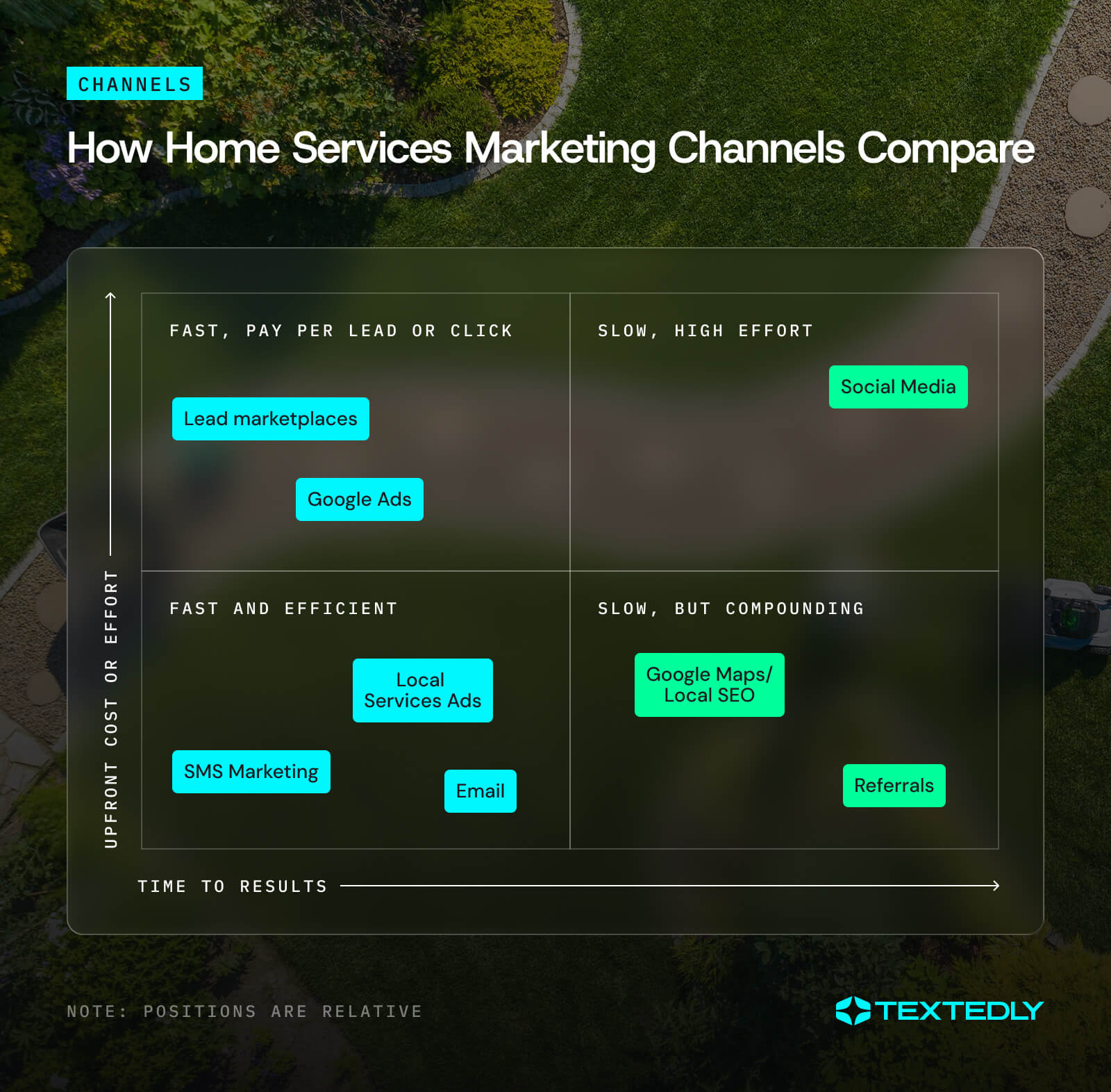
The right mix of marketing depends on your budget, size, and goals. It’s a good idea to mix at least one long-term channel with at least one short-term channel. That way, you can start working on longer-term and immediate leads at the same time.
SMS Compliance For Home Services
When you start communicating with customers via SMS, you need to ensure you’re following federal and state rules.
There are many SMS compliance details to get right, so you should read the legislation carefully, get advice, and use compliant services. Here’s a quick list of some of the most important rules:
- Consumers must opt in: You can’t send people SMS messages without their explicit permission, and what this permission looks like depends on the purpose of the communication.
- Transactional texts require a previous relationship or consent: Replying to a customer to book an appointment or texting alerts about a booked service requires that they’ve shared their information with you voluntarily. These texts cannot contain promotions.
- Promotional texts require prior written consent: These include marketing materials and offers. Usually, consent takes the form of a checkbox in an online form or a follow-up after someone sends you a communication requesting permission.
- Consumers must be able to opt out of promotional texts: Every automated communication should include an easy way for them to stop receiving messages. You’ll see something like “Reply STOP to opt out” in the templates on this page.
Federal acts you should pay attention to include the Telephone Consumer Protection Act and the CAN-SPAM Act.
Textedly offers complete SMS compliance tools to protect the businesses that rely on it. Its features and resources make it easy to follow regulations, so you can communicate with confidence.
Common Home Services Marketing Mistakes
The biggest mistakes in home marketing tend to come from lack of information and lack of follow-up. If you don’t have a dedicated marketing team, you might not even know how much of your existing network you could turn into new business.
These are some of the most common issues:
Slow follow-up: When someone is looking for a service, they’re likely checking you and your competitors all at once. Automating your follow-up and allowing customers to book time slots right away helps you secure a sale, and then you can follow up when you’re ready.
Not tracking lead sources: If you don’t know where leads come from, you don’t know which channels to invest in. As part of your pre- or post-appointment SMS automations, you could include a quick questionnaire to ask how they heard about you.
Ignoring past customers: Today’s customer might need you again next month, next quarter, or next year. Annual subscriptions, automated follow-ups, and review responses help you keep up with your clients.
Depending on a single channel: Each marketing channel has distinct costs, timelines, and win rates. Experiment with a mix and keep track of the results.
Start Turning More Leads Into Booked Jobs
SMS marketing can help you in almost every channel. You can automate responses to leads that come from your website, ads, or even physical flyers. Texts typically get read in minutes and have a 98% open rate, which means they can help secure sales that might otherwise get lost.
With Textedly’s AI agents, you can let customers book appointments while you sleep, re-engage previous customers, and create high-conversion messaging for your campaigns.
Get started to discover how automated SMS marketing can keep your calendar full.
Frequently Asked Questions
How much should a home service business spend on marketing?
How much a home service business should spend on marketing depends largely on your business, expenses, lead value, and channel. Generally, your revenue should be higher than your marketing plus operating costs. Home services should invest in local marketing that ties directly to leads and booked appointments, such as local ads and SMS marketing. Track the revenue from each channel so you can adjust the spend.
What’s the best channel for home service leads?
The best marketing channels for home service leads include Google Maps, Google Ads, Local Services Ads, SMS, email, your website, and physical marketing like mailers. Which one wins out for you will require testing, because it depends on your industry and community.
How do I get more reviews?
The best way to get more reviews is to ask your customers for them. You can send follow-ups and reminders after customers make purchases or complete appointments. Textedly offers review management software that helps you automate requests.
Can I text customers?
Yes, you can text your customers, but you need their consent to comply with federal law. Texts are a great way to remind them of appointments, follow up on estimates, and ask for referrals.
Related resources:
Related Articles

How to Send SMS From Shopify Using Textedly Integrations

7 Benefits of Using QR Codes in Your SMS Marketing Strategy

AI in Customer Service: Tips, Use Cases, & How to Choose

Plumber Marketing Strategies: 12 Ways to Book More Jobs


Your Customers Are Waiting
Send your first text in minutes—no contracts, no credit card, no hassle.