Brick-and-Mortar Marketing: 10 Tactics To Win Regulars
Brick-and-mortar marketing runs in a loop, from a local search to a return visit. Learn the five stages, the tactics that fit each one, and which to try.

KEY TAKEAWAYS
- Brick-and-mortar marketing has to reach people before they walk in, then give them a reason to come back. SOCi’s 2026 Local Discovery Index found that 83% of consumers use search engines to discover local businesses, 55% use social media, and 52% use AI tools, often moving among all three before they choose.
- Start with the tactics that cover the most ground: fill out your Google Business Profile, answer every call and SMS message, and ask for a review after every visit.
- Map each tactic to a stage of your customer’s journey. A lack of tactics at one stage stops the other stages from paying off.
- An SMS customer engagement platform like Textedly can cover all five stages of that journey.
Brick-and-mortar marketing refers to all the tactics businesses use to get people into a physical store or service business. These touchpoints work together to turn interested people into customers. SOCi’s 2026 Local Discovery Index found that 83% of consumers use search engines to discover local businesses, 55% use social media, and 52% use AI tools, often moving in a loop among all three before they choose.
The same interaction happens between in-person and online marketing channels. Someone finds you on Google, texts to check your hours, buys in person, and then sees a coupon that brings them back a month later. Let’s go over some tactics to try and a brick-and-mortar marketing strategy to turn visitors into repeat customers.
10 Marketing Tactics for Brick-and-Mortar Businesses
Each of these tactics covers at least one stage in the process of a customer finding and returning to your business. They begin with options for helping people find you and end with ways to turn the first visit into repeat transactions.
1. Optimize Your Google Business Profile
Before you try any other option on this list, make sure you have your Google Business Profile filled out with your store’s details. This profile is the first thing potential customers see when they search for a business like yours and where their first contact with you can happen. The most important fields to check are the photos of your location, your contact information, your hours, and your service areas.
2. Make Your Business Visible to AI Assistants
Besides Google, people now ask AI assistants like ChatGPT for local recommendations. Those answers come from places like:
- Your business profile data
- What people say about your business in reviews and on websites like Reddit
- Your website or online store
While you can’t control what people say about your business, you can keep your website and Google Business Profile accurate. Since AI doesn’t give multiple results like a search engine, you’ll want it to share correct information on its first try.
3. Run Location-Based Ads
Brick-and-mortar advertising attracts the most relevant audiences when you target people nearby. Google Ads and social media ads offer the option to show your campaigns only to people in your location. If you have an online business, too, you can create ads for your physical location set to show only to people in the area.
4. Build a Compliant, Carrier-Registered SMS Marketing Strategy
Carriers filter out SMS messages from numbers that don’t follow regulations, so compliance is your ticket to entry for SMS marketing. Follow the TCPA’s compliance rules for consent and sign up for a 10DLC number to get your messages through.
The effort is worth it because SMS marketing can give your brick-and-mortar business many benefits:
- You can track the results of your SMS messages to improve your future campaigns.
- It’s easy for customers to join your SMS list through keywords and QR codes you can include in your physical marketing materials.
- SMS allows for fast delivery for coupons, updates, and other communications that require a fast turnaround time.
5. Answer Your Calls and SMS Messages
Create a system to answer every call and SMS message you get from potential customers. Your brand reputation impacts your brick-and-mortar marketing success, especially now that AI uses public opinion to inform its results. And your team’s ability to respond to customer calls and SMS messages influences that reputation.
The right option for your team might simply be keeping your business cell on you while you work. But if you notice after-hours communications slipping through, it might be time to set up a customer communication platform.
One of these tools’ AI voice and SMS agents can take over as a receptionist when your business is closed to answer simple questions and send the harder issues your way. You can also set up conversation triggers that send automatic responses when a customer mentions a certain word in an SMS message.
6. Add SMS Messaging Opportunities Everywhere People Find You
Speaking of SMS messaging, you should make it easy for customers to message you in the first place. Besides including your phone number on your online profiles and website, you can also use contact cards to encourage customers to add you to their contacts.
You’ll also want to keep your SMS marketing campaigns visible to create opportunities to message customers. For example, you can add a web form to your site where customers can join your SMS list.
7. Run Bounce-Back and Loyalty Campaigns
As you research marketing strategies for your retail business or service, you’ll probably see a lot of mentions of loyalty programs. Loyalty programs are a great way to encourage customers to come back.
But you probably won’t see advice to add a bounce-back step. If you decide to send a loyalty program promotion, try limiting it to a tight time window. Compare these two texts:
You’ve earned $10 in rewards, [Name]! Use them on your next visit. Details here: [link]. Reply STOP to opt out.
You’ve earned $10 in rewards, [Name]! Redeem them in one week. Show this text at the register: [link]. Reply STOP to opt out.
Customers can put off the first offer forever. The second gives them a reason to come in this week plus an outcome (redeeming the rewards) to measure your offer’s success.
8. Capture Contact Info at the Point of Sale
All of the tactics on this list so far become moot if you can’t connect in-person visitors to their contact info. When you can’t connect a physical purchase to a contact, it becomes much harder to engage with that customer again. But the solution is pretty simple: Ask customers to share their contact information at the point of sale.
Of course, most customers won’t want to share their contact information without a reason, so you need to offer an incentive. This could be a loyalty program or the promise of promotions and updates from regular communications.
From there, you can use an AI contact enrichment tool to keep your contact list in tip-top shape. But always get someone’s consent before adding them to your SMS or email list to stay compliant. (Not to mention it follows the golden rule.)
9. Make Offers Trackable With Unique Codes
One more opening you might have in your brick-and-mortar strategy is a lack of trackable promotions. You can’t tell which of your coupons bring in customers without some way to connect them to transactions.
Short links can handle this job for SMS promotions. If you use an SMS marketing platform with a built-in short link feature, you can turn regular links into trackable clicks.
You could also connect your point-of-sale system to your communication platforms with an automation tool like Zapier. Depending on your setup, you can enter coupon information during a transaction and link it to a contact or message.
10. Request Reviews After Every Visit
Once you have visitors coming in thanks to your brick-and-mortar marketing tactics, you can compound your results with review requests. This tactic can be as simple as asking people to leave a Google review after a transaction.
But you can also automate this process through communication or automation software. For example, you could set up an SMS message to send after someone visits your location:
Hi [Name], glad you stopped in at [Business]. Would you rate your visit? Your feedback helps us improve: [link]. Reply STOP to opt out.
Tip: Customer review software can help you respond to and analyze your reviews once they start coming in.
How To Turn Marketing Tactics Into a Strategy That Wins Repeat Customers
Map your brick-and-mortar marketing tactics to the stages that customers move through to get more repeat business. Each of the above options covers at least one of these steps, and they run in a loop that ends with a recommendation to another customer:
- Discovery: A customer searches for a local business using tools like search engines or AI. Your job is to keep your business’s online information accurate and engaging.
- Contact: They contact the business to ask a question or schedule an appointment. Here, you can answer these questions quickly and consistently.
- Transaction: After spending money at your business, your customer has the chance to share their contact information at the point of sale. During transactions, you’ll need to give customers a reason to hand those details over.
- Re-engagement: The customer comes back to your business if they had a positive experience. It’s on you to give them a reason to return.
- Reputation: As a repeat customer, the customer leaves a review or tells a friend about your business. Your task is to ask for that recommendation every time.
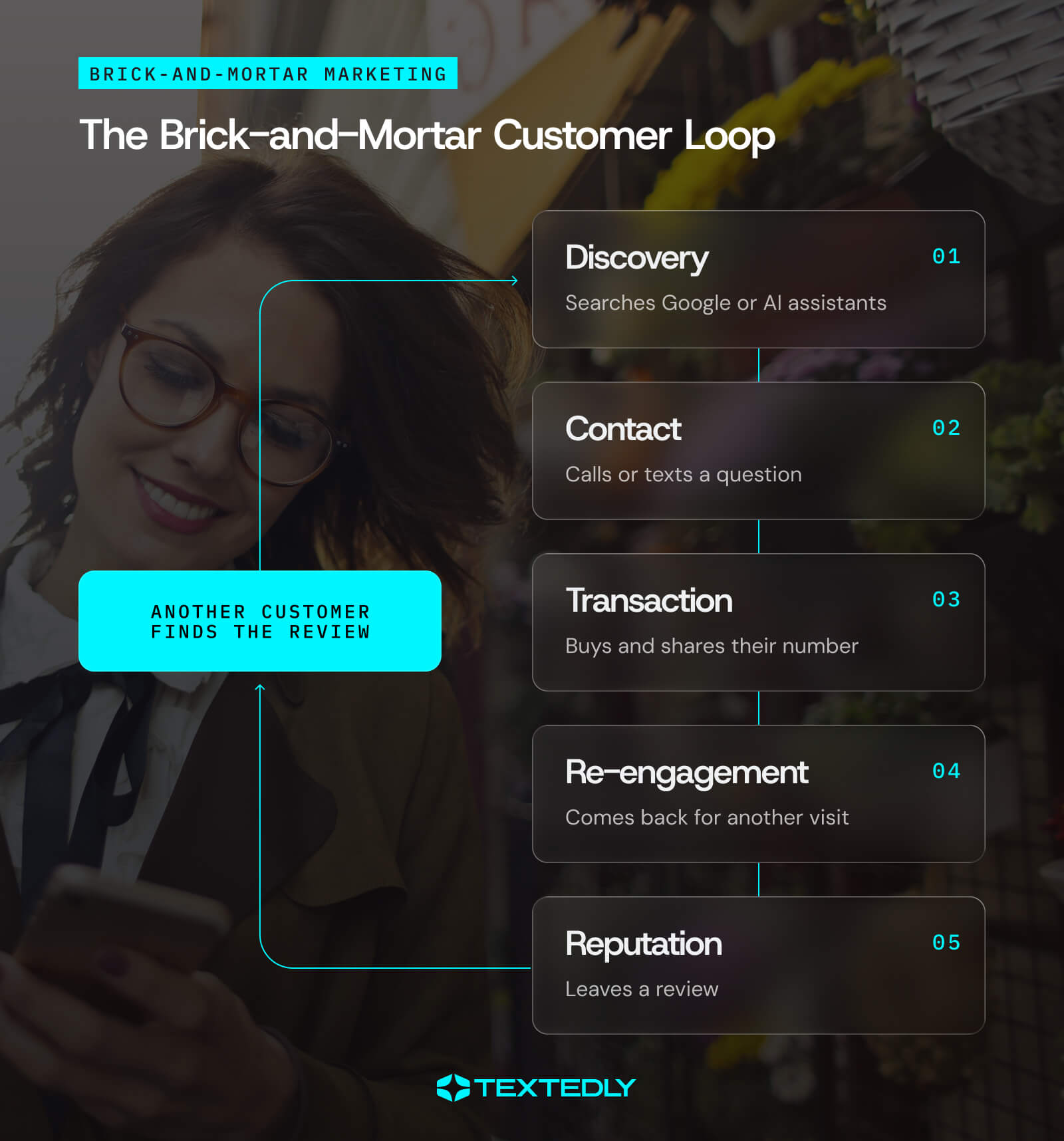
Then the loop starts again when someone else sees that customer’s review or hears about your business from them. A mix of tactics that covers each stage of the loop will keep customers moving through it, letting your marketing build on itself.
Since the steps in a customer journey are linked, an issue at one stage can cause someone to drop off at another. Here’s where each tactic fits into that process:
Keep Customers Engaged With Textedly
Think back to how customers move through your business. Most of these tactics handle one or two of those stages, but a customer engagement platform can run through all five.
A customer texts a question, shares their number at checkout, gets a drip message that brings them back, and leaves a review.
And Textedly can connect those moments in one conversation. Customer engagement runs through Textedly, from initial drip campaigns to post-visit SMS Business Reviews. Create your account and bring your brick-and-mortar SMS marketing strategy together.

Related Articles

Home Services Marketing: 11 Strategies To Get More Leads

10 of the Best AI Messaging Platforms for Businesses

AI in Customer Service: Tips, Use Cases, & How to Choose

How to Send SMS From Shopify Using Textedly Integrations


Your Customers Are Waiting
Send your first text in minutes—no contracts, no credit card, no hassle.